
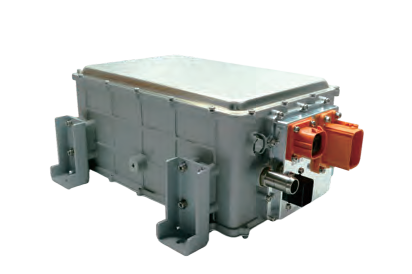
22kw on board charger
Product Short Description
The ultimate power conversion solution for high-capacity battery architectures. Our 22kW On-Board Charger (OBC) provides industry-leading charging speeds for electric buses, heavy-duty trucks, and luxury EVs. By utilizing a high-efficiency Silicon Carbide (SiC) platform, this OBC achieves up to 97% efficiency, significantly reducing charging times compared to standard 7kW or 11kW units. Designed for global 3-phase power compatibility, it features fully isolated CAN 2.0B communication and a rugged, vibration-resistant aluminum enclosure.
-
Rated Power: 22kW (3-Phase 400V/480V AC)
-
Voltage Range: 200V – 500V (Standard) / 450V – 850V (800V Architecture)
-
Peak Efficiency: ≥ 96.5%
-
Cooling: Advanced Liquid Cooling (Water/Glycol)
-
Protection: IP67 Waterproof & Dustproof
High-Amperage Engineering for Industrial Mobility
The 22kW Standard: Cutting Charging Time in Half
In the commercial and high-performance EV sectors, downtime is a critical cost. A 22kW on-board charger allows a typical 100kWh battery pack to reach a full charge in just 4.5 to 5 hours via standard AC infrastructure. This level of throughput is essential for fleet logistics, transit buses, and premium passenger vehicles that require rapid turnaround without the infrastructure costs of DC fast-charging stations.
Technical Expertise & Safety Integrity
Managing 22kW of AC-to-DC conversion within a compact vehicle footprint requires superior thermal and electrical engineering. Our units are built to exceed the most demanding automotive standards:
-
Next-Generation SiC MOSFET Architecture: We utilize Silicon Carbide (SiC) power modules to facilitate high-frequency switching. This results in a smaller magnetic footprint, reduced electromagnetic interference (EMI), and significantly lower heat dissipation compared to traditional IGBT-based chargers.
-
Intelligent Thermal Management: To ensure Trustworthiness, our 22kW unit features an integrated liquid-cooling baseplate. It maintains optimal operating temperatures even under continuous full-load conditions, with active derating protocols to protect the electronics at ambient temperatures up to 85°C.
-
Redundant Modular Design: The internal circuitry is structured for high reliability. In the event of a partial system fault, the charger can often continue operating at reduced power, ensuring the vehicle is never left stranded.
-
Advanced CAN Bus Handshake: Total system synergy is achieved via CAN 2.0B (ISO 11898). The OBC maintains a real-time data link with the Vehicle Control Unit (VCU) and Battery Management System (BMS) to execute precision CC/CV (Constant Current/Constant Voltage) charging profiles.
Technical Specifications
| Feature | 22kW OBC Specification |
| Input Voltage (3-Phase) | 304V – 456V AC (Standard) / Up to 480V AC |
| Max Input Current | 32A per Phase |
| Output Voltage Range | 200V DC – 500V DC (Standard) / 450V – 850V DC |
| Max Output Current | 60A – 80A DC (Depending on voltage config) |
| Power Factor (PFC) | ≥ 0.99 at Full Load |
| Harmonic Distortion | THD≤ 5% (Compliant with IEEE 519) |
| Galvanic Isolation | ≥ 2500V AC |
| Operating Temp | -40°C to +85°C |
| Protection Rating | IP67 / IK10 |
🛠️ Expert Application & System Integration
Our 22kW OBC is the professional choice for high-duty cycle platforms:
-
Heavy-Duty Transit: Ideal for electric buses and medium-duty delivery trucks requiring fast AC depot charging.
-
High-Performance EVs: The gold standard for premium vehicles utilizing 800V battery systems and 3-phase home wallboxes.
-
Specialty Marine & Industrial: Optimized for electric boats and off-road mining equipment operating in harsh, high-vibration environments.
Frequently Asked Questions (FAQ)
Q: Does this OBC support 800V vehicle architectures?
A: Yes. We offer a high-voltage variant specifically engineered for 800V systems (supporting up to 850V DC output), ensuring compatibility with the latest generation of ultra-fast charging platforms.
Q: Why is liquid cooling required for a 22kW unit?
A: Converting 22kW of power generates significant thermal energy. Liquid cooling provides the most efficient heat transfer, allowing the unit to remain compact while maintaining the high power density required for automotive integration.
Q: Is the CAN protocol customizable for our VCU?
A: Absolutely. We provide a comprehensive CAN Communication Matrix and technical support to ensure the OBC integrates seamlessly with your vehicle’s specific control logic and BMS parameters.