
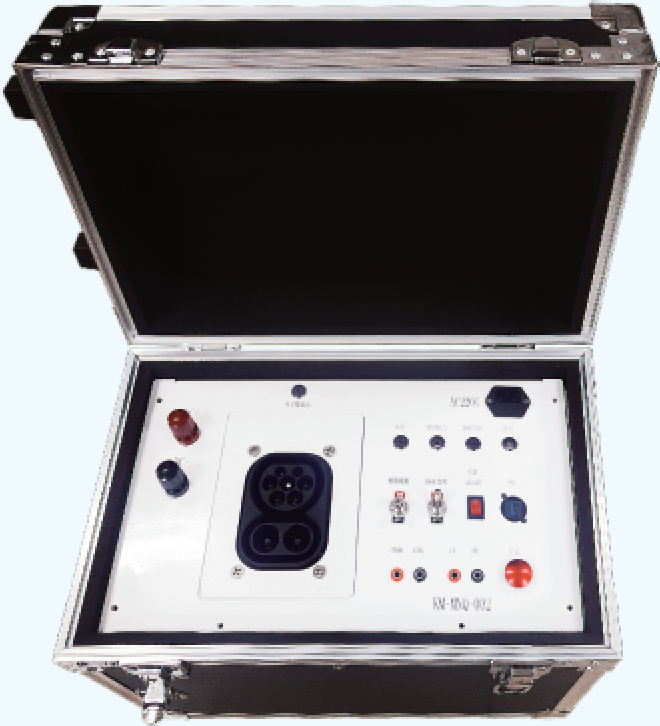
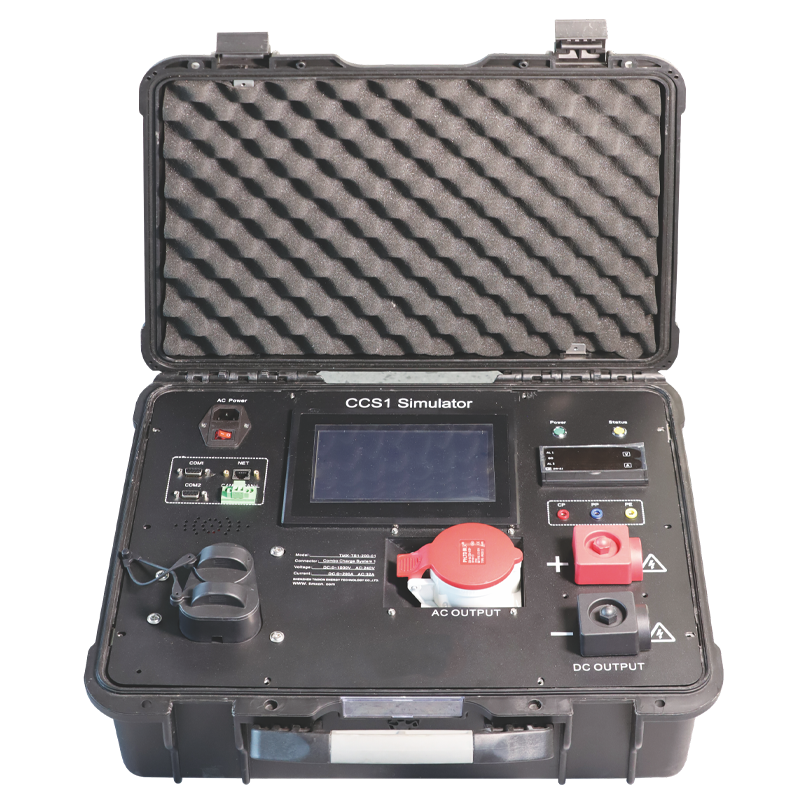
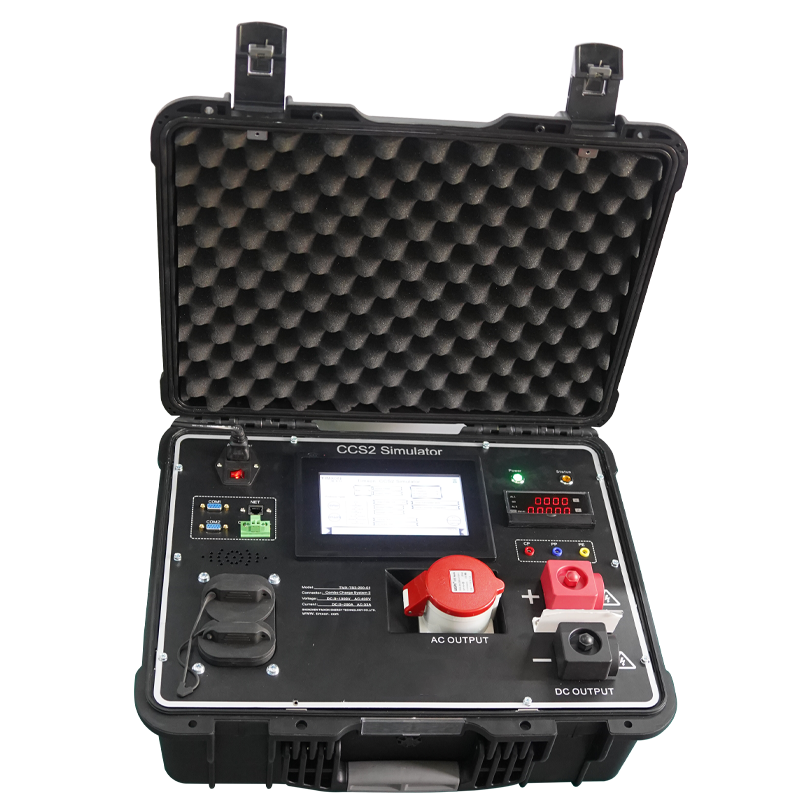
EV Charging Simulator
Accelerate your EVSE development without the need for a real electric vehicle.
Our Professional EV Charging Simulator allows you to simulate a wide range of EV behaviors, battery states, and communication protocols. Whether you are testing high-power DC fast chargers or smart AC stations, this tool provides a safe, repeatable, and highly accurate environment for validation.
-
Comprehensive Simulation: Covers CCS1, CCS2, NACS, and GB/T standards.
-
Protocol Validation: Full support for ISO 15118-2/-20, DIN 70121, and OCPP testing.
-
Fault Simulation: Test safety limits by simulating insulation faults, overvoltage, and communication errors.
-
Portable & Lab-Ready: Compact hardware for field testing and API support for automated lab integration.
The Ultimate Testing Solution
The EV charging infrastructure market is evolving rapidly. To stay ahead, manufacturers must ensure their charging stations (EVSE) are compatible with every vehicle on the road. The MAIYUXIN EV Charging Simulator acts as a “Virtual EV,” allowing you to conduct rigorous end-to-end testing without the logistical headache or safety risks of using real electric cars.
Key Features & Capabilities
-
Multi-Standard Interoperability
Switch seamlessly between global standards. Our hardware simulates the physical and logical layers for CCS Combo 1 & 2, CHAdeMO, GB/T, and the emerging NACS (J3400). -
Deep Protocol Analysis
Verify the handshake process in detail. Monitor and debug the PLC (Power Line Communication) and PWM (Pulse Width Modulation) signals. Validate V2G (Vehicle-to-Grid) features and Plug & Charge sequences via ISO 15118. -
State-of-Charge (SoC) & Battery Simulation
Configure custom battery voltage curves and SoC levels. Test how your charger handles a nearly full battery versus a completely depleted one, and verify power curtailment logic. -
Safety & Stress Testing
Proactively test how your charger responds to “worst-case scenarios.” Simulate stuck contactors, pilot signal loss, insulation leakage, and emergency stop triggers in a controlled environment. -
Automated Testing GUI & API
Use our intuitive Windows/Linux software to visualize real-time data or use our Python/C++ API to integrate the simulator into your automated CI/CD hardware-in-the-loop (HiL) test benches.
Why Invest in a Dedicated EV Simulator?
-
Reduce R&D Costs: Avoid the expense of purchasing and maintaining multiple test vehicles.
-
Safety: Safely simulate high-voltage faults that would be dangerous to perform on a real car.
-
Efficiency: Replicate specific error codes and corner cases instantly to debug software bugs in minutes, not days.
-
Compliance: Prepare your equipment for CE, UL, or CharIN certification with pre-compliance testing.
4. Technical Specifications Table
| Feature | Technical Details |
| Supported Standards | CCS1, CCS2, NACS (J3400), GB/T 27930, CHAdeMO |
| AC Simulation | Type 1 & Type 2 (1-Phase / 3-Phase) |
| DC Simulation | Up to 1000V / 500A (Scalable) |
| Communication Protocols | ISO 15118-2/-20, DIN 70121, PWM (IEC 61851-1) |
| Connectivity | USB, Ethernet (TCP/IP), CAN-bus |
| Operating Voltage | 110V/220V AC Input |
| Simulation Modes | Manual Control, Sequence Playback, Remote API |
5. Use Cases
-
EVSE Production Line Testing: Final functional checks before shipping charging units.
-
Interoperability Labs: Testing new firmware against different vehicle “profiles.”
-
Field Service & Maintenance: Diagnosing charging failures at public charging hubs.
-
Smart Grid Research: Simulating V2X (Vehicle-to-Everything) load profiles for utility impact studies.
Contact
+86 15921155462
Ariel.fang@maiyuxin.com
No. 1 Building, 789 Lane, Tianzhu Road, Jiading District, Shanghai, China
Copyright © 2025 All Right Reserved MAIYUXIN