
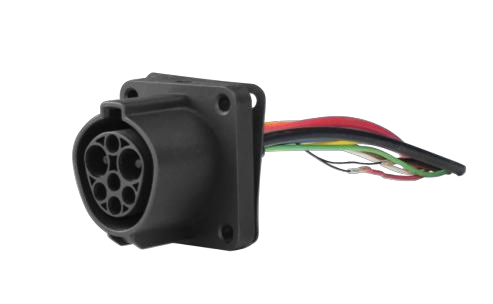
IEC 612196-6 Type 6 inlet
IEC 62196-6 Type 6 Vehicle Inlet | DC Charging for Light Electric Vehicles (LEV) | 100A 120VDC
The IEC 62196-6 Type 6 Inlet is the international standard for the next generation of Light Electric Vehicle (LEV) charging infrastructure. Specifically engineered for e-scooters, electric motorcycles, and micro-mobility platforms, this inlet provides a standardized, safe, and highly durable DC interface. By moving toward a unified “Type 6” architecture, manufacturers can ensure global interoperability and a superior user experience at public and private charging points.
Key Product Highlights
-
Standardized Compliance: Fully compliant with IEC 62196-6 and IS 17017-2-6 (Type 6) for universal LEV compatibility.
-
High-Current Performance: Supports continuous DC charging from 20A up to 100A.
-
Industrial Longevity: Engineered to withstand 10,000+ mating cycles, making it ideal for high-frequency public charging.
-
7-Pin Intelligent Interface: Features a 2 Power + 5 Signal configuration for precise communication between the vehicle and EVSE.
-
Extreme Resilience: Operating temperature range from -20°C to +90°C, ensuring reliability in all climates.
Technical Excellence & Engineering Authority
1. Precision Signal Integration
Reliable LEV charging requires more than just raw power transfer. The Type 6 inlet features five dedicated signal pins designed for NTC (Negative Temperature Coefficient) thermal monitoring and IP (Ingress Protection) detection. This ensures the charging session is automatically throttled or terminated if abnormal heat is detected, protecting the vehicle’s battery chemistry.
2. Advanced Material Science
To ensure maximum Trustworthiness, the inlet is constructed from UL94V-0 rated polyamide and polyester thermoplastics. These materials offer industry-leading flame retardancy and impact resistance. The internal terminals are crafted from a high-performance copper alloy, ensuring minimal contact resistance and energy loss during 100A peak delivery.
3. Optimized for Micro-Mobility
Unlike bulky passenger car inlets (like CCS or NACS), the Type 6 is compact and lightweight. It is specifically designed for the unique spatial constraints of two-wheelers and three-wheelers while providing a robust 500VDC dielectric withstanding voltage and insulation resistance of >1GΩ.
Technical Specifications
| Category | Parameter | Specification |
| Electrical | Rated Current | 20A – 120A DC |
| Rated Voltage | Up to 120V DC | |
| Dielectric Voltage | 500V DC | |
| Pin Configuration | 2 Power + 5 Signal (2P5S) | |
| Mechanical | Mating Cycles | ≥ 10,000 Cycles |
| Housing Material | UL94V-0 Thermoplastic | |
| Seal Material | Silicone Rubber | |
| Environmental | Operating Temp | -20°C to +90°C |
| Standard | IEC 62196-6 / IS 17017-2-6 |
Frequently Asked Questions (FAQ)
Q: What is the main difference between Type 6 and other IEC 62196 standards?
A: While IEC 62196-2 and -3 focus on high-power AC and DC for passenger cars (Type 2, CCS), IEC 62196-6 is specifically dedicated to DC charging for LEVs where protection relies on electrical separation, typically involving lower voltages (up to 120V) and currents up to 100A.
Q: Does this inlet support thermal monitoring?
A: Yes. The 5-signal pin configuration allows for the integration of NTC thermistors, providing real-time temperature data to the charging station to ensure safety throughout the 100A charging process.
Q: Is it suitable for outdoor public charging stations?
A: Absolutely. With an IP-rated silicone seal and a wide operating temperature range up to 90°C, this inlet is designed to thrive in outdoor environments and withstand the rigors of public use.