
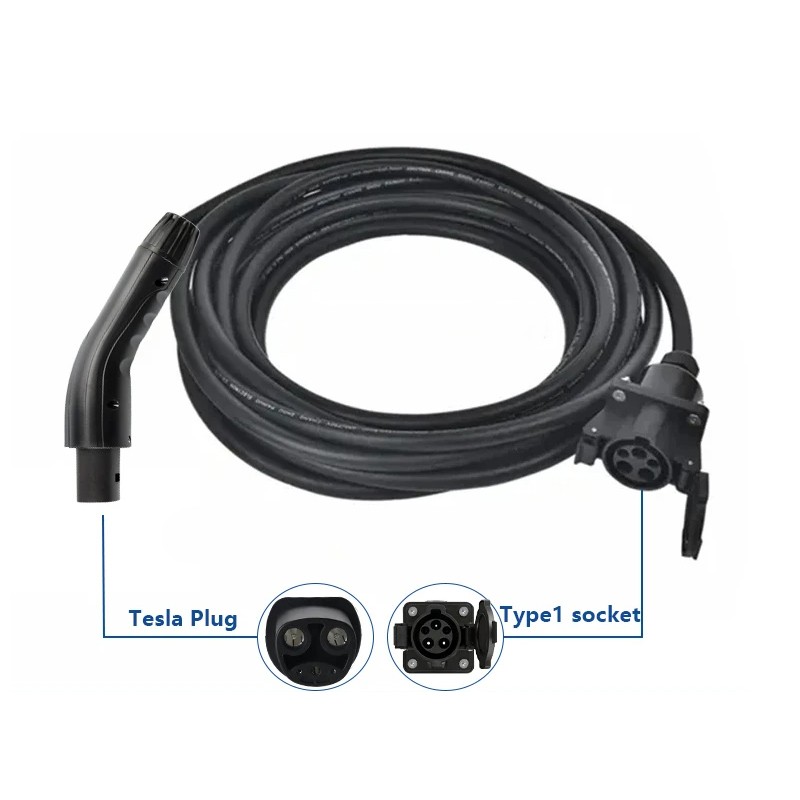
Type 1 to NACS EV Charging Cable
The definitive bridge for the North American charging transition. Our Type 1 to NACS EV charging cable allows vehicles equipped with the North American Charging Standard (NACS) port—including Tesla and upcoming Ford, GM, and Rivian models—to seamlessly utilize Type 1 (SAE J1772) charging stations. Supporting single-phase AC delivery up to 11.5kW (48A), this cable is engineered with silver-plated terminals and a high-flex TPU jacket for superior all-weather reliability.
-
Connector Standard: Type 1 Female (Station Side) to NACS Female (Vehicle Side)
-
Current Ratings: 16A, 32A, 40A, 48A
-
Maximum Power: Up to 11.5kW (at 48A / 240V)
-
Compliance: SAE J3400 (NACS) & SAE J1772 Standards
-
Certifications: UL Recognized, CE, and RoHS Compliant
Engineering for the NACS Infrastructure Shift
Seamless Interoperability for Modern EV Fleets
As the industry converges on the NACS standard, many home wallboxes and public “destination” chargers still utilize the Type 1 (J1772) tethered cable. Our Type 1 to NACS cable provides a high-conductivity, direct-connection solution that eliminates the mechanical stress and electrical resistance associated with stacked adapters. It is the professional choice for Tesla owners and fleets transitioning to NACS-equipped vehicles.
Engineering Authority & Safety
Navigating Level 2 AC power requires precise material science. We prioritize safety and longevity through expert engineering:
-
High-Conductivity Silver Plating: We utilize 5μ silver-plated copper alloy contacts on both ends. Silver offers the lowest contact resistance (≤0.5mΩ), which is critical for preventing terminal heat rise during sustained 40A or 48A charging sessions compared to standard nickel-plated alternatives.
-
Industrial-Grade TPU Jacket: Our cables are jacketed in high-performance TPU (Thermoplastic Polyurethane). Unlike standard PVC, TPU remains supple at -30°C, resists UV radiation in outdoor driveways, and is highly resistant to abrasion and automotive chemicals.
-
Intelligent Signal Translation: The internal Control Pilot (CP) and Proximity Pilot (PP) wires ensure that the Type 1 station and the NACS vehicle establish a perfect handshake. This enables automatic locking and precise current verification, protecting your vehicle’s sensitive Battery Management System (BMS).
-
Rugged Mechanical Reliability: The connector heads are constructed from high-strength thermoplastic, designed to withstand a 2-ton vehicle drive-over test and rated for over 10,000 mating cycles.
Technical Specifications
| Feature | 16A / 32A Specification | 40A / 48A Specification |
| Max Power Output | 3.8kW / 7.6kW | 9.6kW / 11.5kW |
| Connector A | SAE J1772 (Type 1 Female) | SAE J1772 (Type 1 Female) |
| Connector B | NACS / SAE J3400 (Female) | NACS / SAE J3400 (Female) |
| Cable Structure | 3 x 10AWG + 1 x 18AWG | 2x 6AWG + 1 x8AWG + 1 x 18AWG |
| Protection Degree | IP55 (Mated) / IP67 (Body) | IP55 (Mated) / IP67 (Body) |
| Flammability | UL94 V-0 | UL94 V-0 |
| Operating Temp | -30°C to +50°C | -30°C to +50°C |
🛠️ Selection Guide: Which Current is Right for You?
To ensure Trustworthiness and safety, match the cable to your vehicle’s onboard charger:
-
16A (3.8kW): Best for Plug-in Hybrids (PHEVs) and older EVs. This cable is lightweight and highly portable.
-
32A (7.6kW): The industry standard for home charging; provides roughly 25-30 miles of range per hour.
-
40A / 48A (9.6kW–11.5kW): The High-Performance choice for modern EVs like the Tesla Model 3/Y or Ford Lightning. It provides the maximum AC speed permitted by most standard residential Level 2 chargers.
Frequently Asked Questions (FAQ)
Q: Can I use this at a public J1772 station with my Tesla?
A: Yes. This cable connects your Tesla (or any NACS vehicle) to a universal Type 1 (J1772) tethered charging station found in many malls, hotels, and older public parking lots.
Q: Is it safe to leave this cable outside?
A: Absolutely. The connector bodies are IP67 rated, and the cable uses a UL-listed TPU jacket, ensuring it remains functional and flexible regardless of rain, snow, or extreme sun exposure.
Q: Why choose a native cable over an adapter?
A: A native cable reduces the number of electrical contact points, which minimizes heat generation and potential failure points. It also offers a more secure mechanical fit and a cleaner aesthetic.