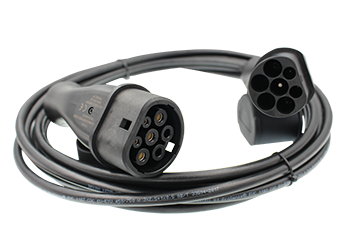
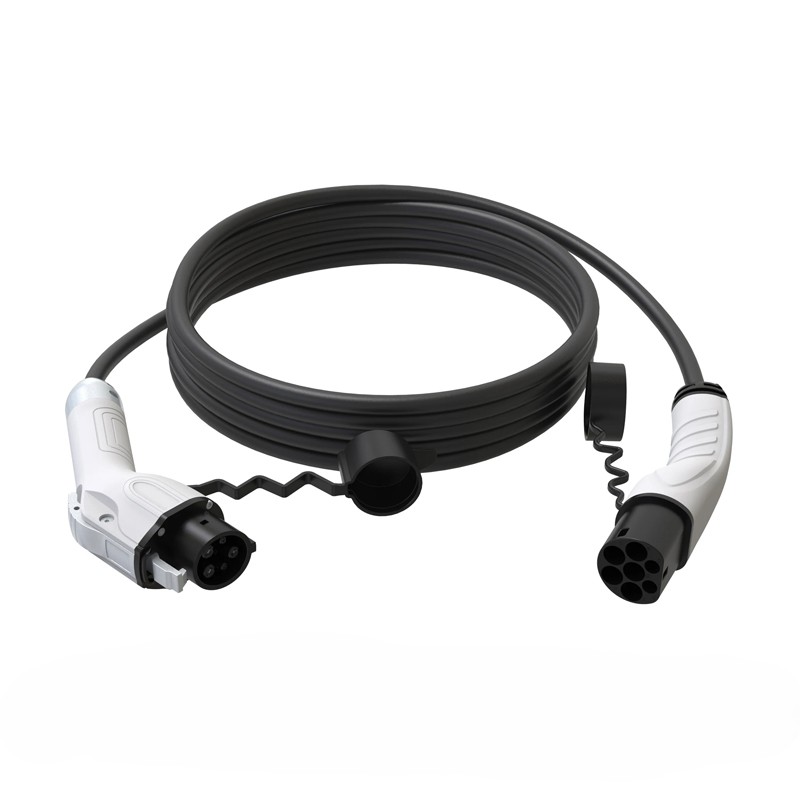
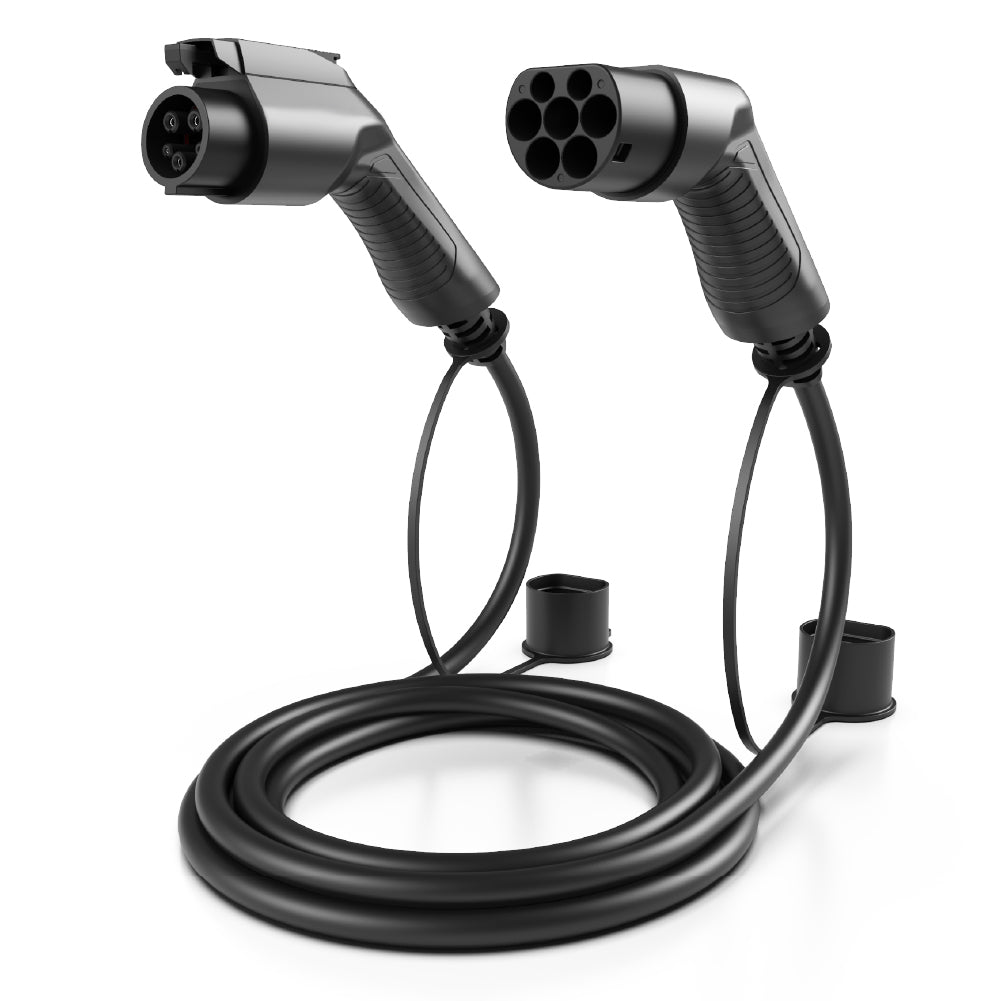
Type 2 to Type 1 ev charging cable
The definitive bridge for global EV compatibility. Our Type 2 to Type 1 EV charging cable allows vehicles equipped with a Type 1 (SAE J1772) inlet to seamlessly utilize Type 2 (Mennekes) universal charging points. Engineered for public and residential charging, this cable supports single-phase power delivery up to 7.4kW. Featuring silver-plated terminals and a rugged, weather-resistant TPU jacket for a lifetime of reliable performance.
-
Connector Standard: Type 2 Male (Station Side) to Type 1 Female (Vehicle Side)
-
Current Ratings: 16A / 32A (Single-Phase)
-
Power Capacity: 3.7kW (16A) to 7.4kW (32A)
-
Material: High-Performance TPU (EN 50620 compliant)
-
Certifications: CE, TUV, and RoHS Certified
Technical Excellence in Power Conversion
Bridging the Global Standard Gap
As the European and Asian charging infrastructure increasingly adopts the universal Type 2 socket, owners of Type 1 vehicles (such as the Nissan Leaf Gen 1, Mitsubishi Outlander PHEV, or North American imports) require a high-quality interface to access these stations. Our Type 2 to Type 1 cable provides an immediate, plug-and-play solution, converting the Mennekes output into the J1772 standard without power loss or communication errors.
Engineering Authority & Safety
Reliability in EVSE hardware is a matter of material science. We prioritize safety and longevity through precision engineering:
-
High-Conductivity Silver Plating: Both connector ends feature 5μ silver-plated copper alloy contacts. Silver offers the lowest contact resistance ($\leq 0.5m\Omega$), significantly reducing heat buildup during continuous 32A charging sessions compared to standard nickel-plated alternatives.
-
Industrial-Grade TPU Jacket: Our cables are jacketed in high-performance TPU (Thermoplastic Polyurethane). Unlike standard PVC, TPU remains supple and easy to coil even at -30°C, resists UV radiation, and is highly resistant to abrasion and automotive chemicals.
-
Seamless Signal Translation: The internal Control Pilot (CP) and Proximity Pilot (PP) wires ensure that the charging station and vehicle establish a perfect handshake. This enables automatic locking and power verification, protecting your vehicle’s sensitive battery management system.
-
Drive-Over Resilience: The connector heads are constructed from high-strength thermoplastic, designed to withstand a 2-ton vehicle drive-over test, ensuring the internal wiring remains protected even in high-traffic public environments.
Technical Specifications
| Feature | 16A Specification | 32A Specification |
| Max Power Output | 3.7kW (Single-Phase) | 7.4kW (Single-Phase) |
| Connector A | IEC 62196-2 (Type 2 Male) | IEC 62196-2 (Type 2 Male) |
| Connector B | SAE J1772 (Type 1 Female) | SAE J1772 (Type 1 Female) |
| Cable Structure | 3 x 2.5mm² + 2 x 0.5mm² | 3 x6.0mm² + 2 x 0.5mm² |
| Protection Degree | IP55 (Mated) / IP67 (Body) | IP55 (Mated) / IP67 (Body) |
| Mechanical Life | > 10,000 Mating Cycles | > 10,000 Mating Cycles |
| Operating Temp | -30°C to +50°C | -30°C to +50°C |
🛠️ Selection Guide: Which Current is Right for You?
To ensure Trustworthiness for your specific vehicle, consider your onboard charger capacity:
-
16A (3.7kW): Ideal for many older Plug-in Hybrids (PHEVs) and city EVs. This cable is lighter, thinner, and more portable for daily use.
-
32A (7.4kW): Recommended for full Battery Electric Vehicles (BEVs) and modern PHEVs. This cable is Future-Proof, as it will safely work with 16A vehicles but allows for full 7.4kW speeds when the infrastructure and vehicle support it.
Frequently Asked Questions (FAQ)
Q: Can I use this cable at a public station in Europe?
A: Yes. This is the standard cable used by Type 1 vehicle owners across Europe and the UK to connect to universal “untethered” Type 2 charging pillars.
Q: Does this cable work with my Tesla?
A: European Tesla vehicles have a Type 2 inlet. If you have a North American Tesla (NACS), you would typically use a dedicated NACS adapter. This cable is specifically for vehicles with the Type 1 (J1772) circular 5-pin inlet.
Q: Is TPU really better than PVC for EV cables?
A: Absolutely. PVC cables become stiff and difficult to manage in winter weather. TPU (our standard) remains flexible and easy to handle in freezing temperatures and has a much higher resistance to UV and mechanical wear.